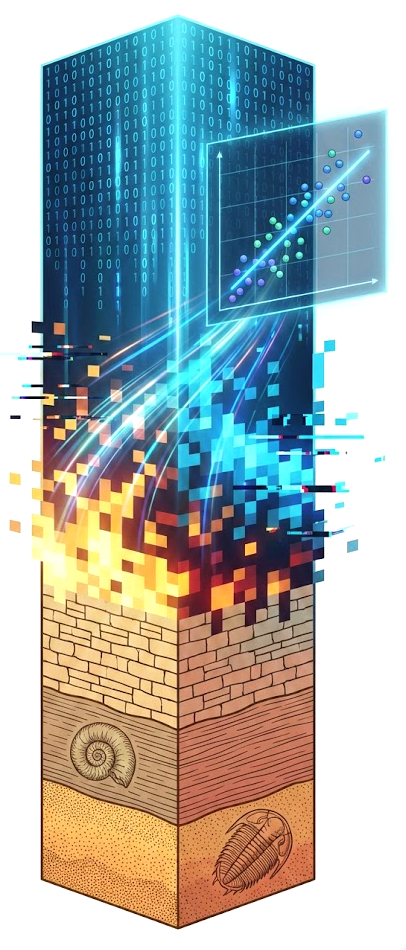
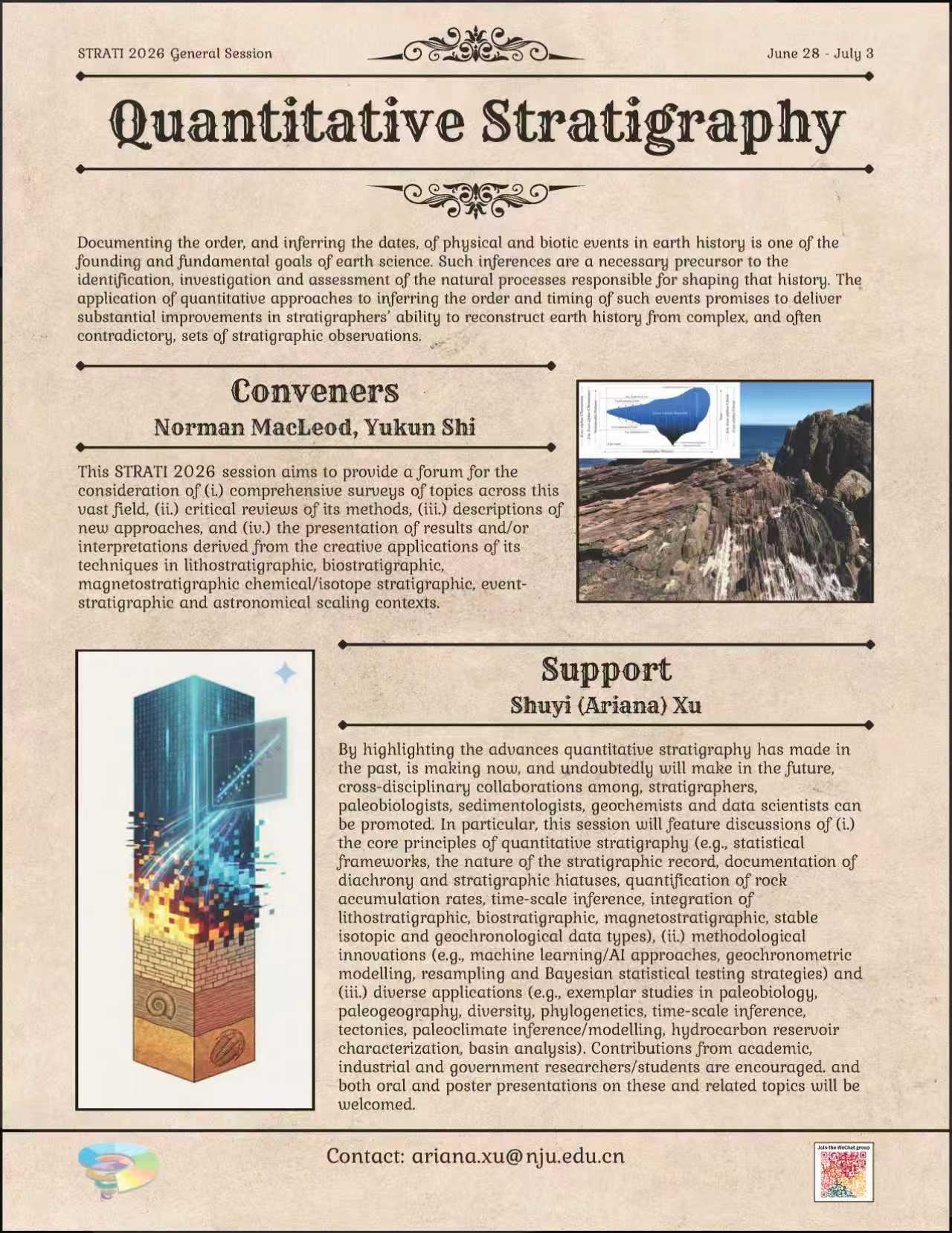
Documenting the order, and inferring the dates, of physical and biotic events in earth history is one of the founding and fundamental goals of earth science. Such inferences are a necessary precursor to the identification, investigation and assessment of the natural processes responsible for shaping that history. The application of quantitative approaches to inferring the order and timing of such events promises to deliver substantial improvements in stratigraphers’ ability to reconstruct earth history from complex, and often contradictory, sets of stratigraphic observations. This STRATI 2026 session aims to provide a forum for the consideration of:
(i.) comprehensive surveys of topics across this vast field,
(ii.) critical reviews of its methods,
(iii.) descriptions of new approaches, and
(iv.) the presentation of results and/or interpretations derived the creative applications of its techniques in lithostratigraphic, biostratigraphic, magnetostratigraphic chemical/isotope stratigraphic, event-stratigraphic and astronomical scaling contexts.
By highlighting the advances quantitative stratigraphy has made in the past, is making now, and undoubtedly will make in the future, cross-disciplinary collaborations among, stratigraphers, paleobiologists, sedimentologists, geochemists and data scientists can be promoted. In particular, this session will feature discussions of:(i.) the core principles of quantitative stratigraphy (e.g., statistical frameworks, the nature of the stratigraphic record, documentation of diachrony and stratigraphic hiatuses, quantification of rock accumulation rates, time-scale inference, integration of lithostratigraphic, biostratigraphic, magnetostratigraphic, stable isotopic and geochronological data types), (ii.) methodological innovations (e.g., machine learning/AI approaches, geochronometric modelling, resampling and Bayesian statistical testing strategies) and (iii.) diverse applications (e.g., exemplar studies in paleobiology, paleogeography, diversity, phylogenetics, time-scale inference, tectonics, paleoclimate inference/modelling, hydrocarbon reservoir characterization, basin analysis).
Contributions from academic, industrial and government researchers/students are encouraged. Both oral and poster presentations on these and related topics will be welcomed.
Abstract Deadline: 15 April 2026
In order to submit an abstract you must go to the congress web page where you will find a link to the abstract submission section. You do not have to register for the congress or pay a fee to submit an abstract.
Contacts:



Posters
Please download a copy and put it up in your department.
English
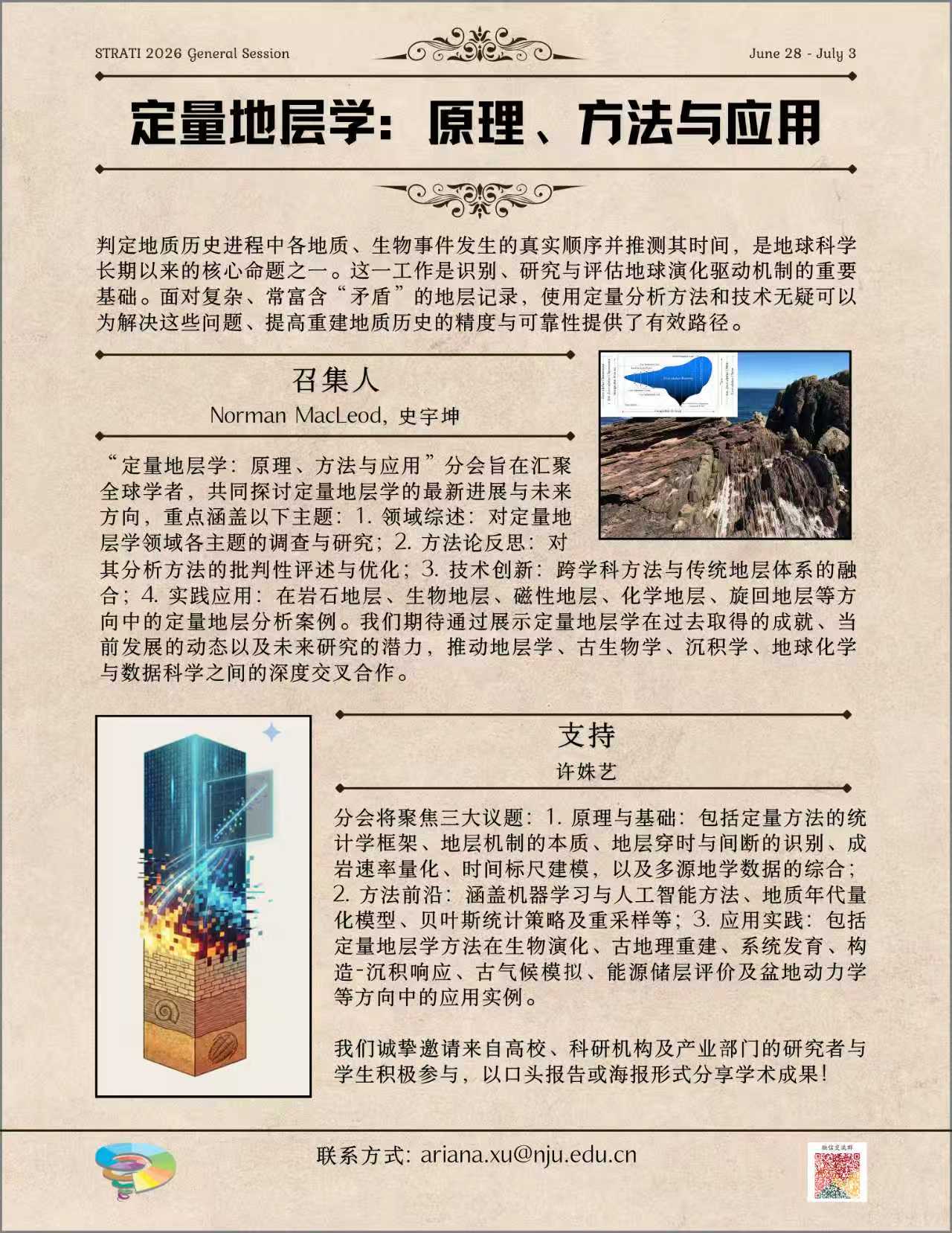
Chinese